
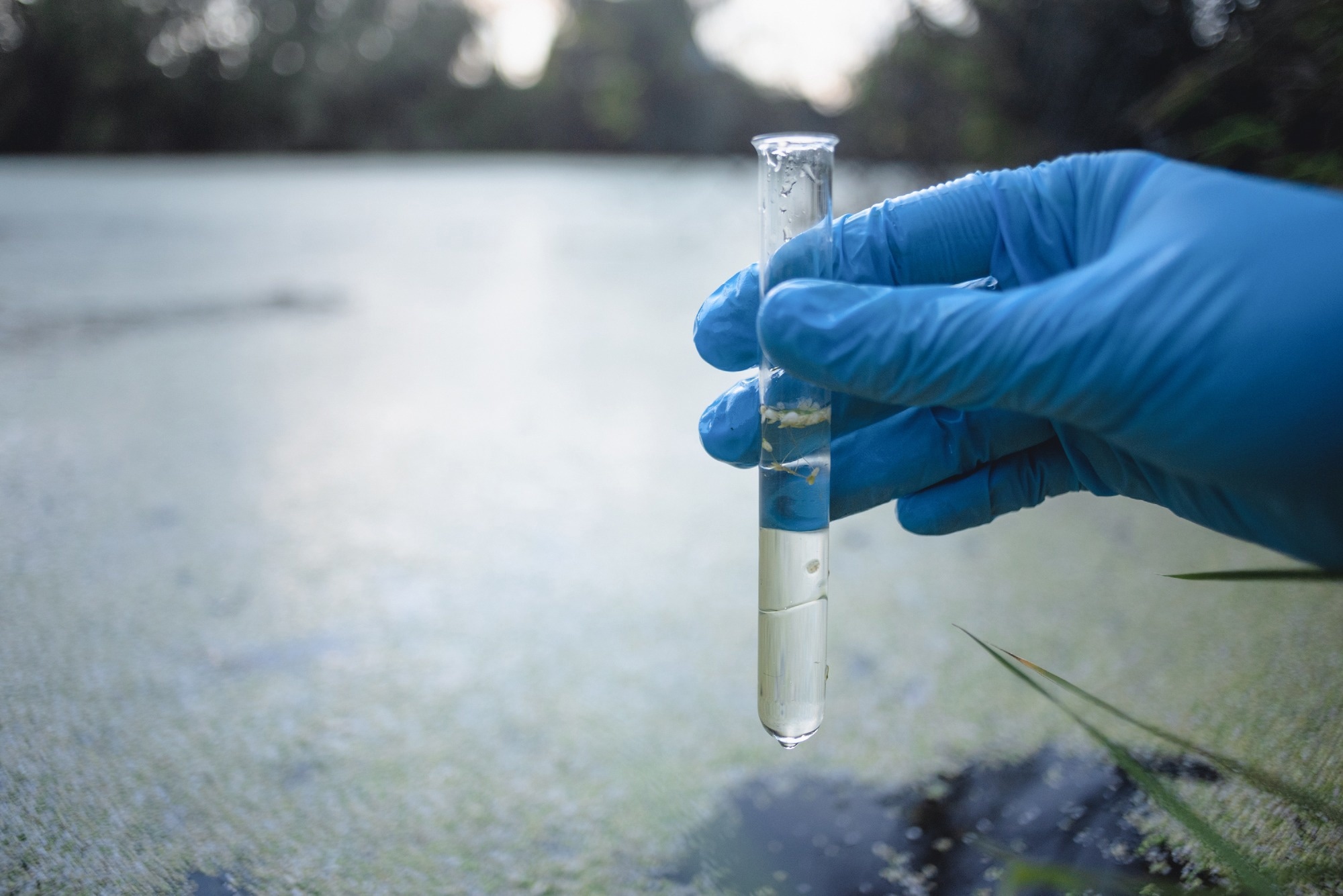
Tested on Chernobyl wastewater, scientists have created a magnetic carbon-clay hybrid that scrubs radioactive waste clean – a new benchmark for sustainable water treatment.
 Image Credit: Happy_Nati/Shutterstock.com
A research team has developed a nano-functionalized magnetic carbon composite that efficiently removes heavy metals, oil products, and radioactive contaminants from water, including samples collected from the Chernobyl Exclusion Zone.
The study, published in C, demonstrates how nanotechnology can power the next generation of water purification systems aimed at tackling pollution from both industrial and nuclear sources.
As industrial activity and nuclear waste continue to impact ecosystems, conventional treatment systems are largely unable to handle complex pollutants. This study explored thermally expanded graphite (TEG), a material with a large surface area and strong hydrophobic properties, as a solid foundation for advanced sorbents.
By combining TEG with bentonite clay, known for its ion-exchange capacity and environmental safety, the scientists produced a magnetically responsive composite capable of trapping metals, radionuclides, and organic contaminants.
The result is a hybrid material that efficiently captures polar and non-polar pollutants, such as oil residues and radioactive isotopes.
Design and Testing
To create the material, scientists combined high-purity graphite with sulfuric acid, applying thermal treatment post-reaction to expand its layers. They embedded iron and iron oxide micro- and nanoparticles into the structure, giving it magnetic properties so it could easily be recovered after use in water treatment.
To confirm its structure and adsorption performance, the composite was characterized with scanning electron microscopy (SEM), transmission electron microscopy (TEM), and atomic absorption spectroscopy (AAS).
Testing involved simulated radioactive wastewater and real samples from Chernobyl’s “Shelter” site. Researchers varied TEG-to-bentonite ratios and used mechanical activation to improve uniformity and sorption efficiency.
Download PDF to grab all the details!
Test Results
The composite achieved impressive results:
- COD reduction: from 1500 to 135 mgO2/dm3
- Metal removal: cesium (81.4 %), strontium (89.9 %), manganese (~99 %)
- Radionuclide removal: americium-241 and europium-154 eliminated at over 99.99 % efficiency.
When the team applied the composite treatment to real radioactive wastewater from Chernobyl, radioactivity levels dropped by three orders of magnitude. A second purification step using a ferrocyanide-based sorbent brought total decontamination efficiency to 99.99 %.
In addition, the material maintained its structure and performance over multiple cycles, a key indicator of long-term usability.
Practical and Future Applications
These results clearly indicate the TEG-bentonite composite’s potential for use in nuclear, oil and gas, and municipal wastewater systems. Its ability to remove heavy metals, radionuclides, and organic residues, including those in microplastic-contaminated wastewaters, makes it a versatile tool for environmental remediation. Its magnetic responsiveness simplifies recovery, reducing waste and cost in treatment operations.
With ever-increasing regulations and greater demand for cleanup, materials like this could play a vital role in sustainable water management. The study highlights the need to develop scalable, eco-efficient solutions for regions with long-standing industrial or nuclear pollution challenges.
Prospects
Future research will focus on optimizing composite formulation, testing its performance under varied environmental conditions, and scaling production for field applications.
Long-term stability, affordability, and life-cycle impacts will guide the next development phase, but these results already indicate a promising move toward safer, cleaner water systems.
Journal Reference
Melnychenko, T, I., et al. (2025, October). Nano-Functionalized Magnetic Carbon Composite for Purification of Man-Made Polluted Waters. C, 11(4), 77. DOI: 10.3390/c11040077, https://www.mdpi.com/2311-5629/11/4/77