
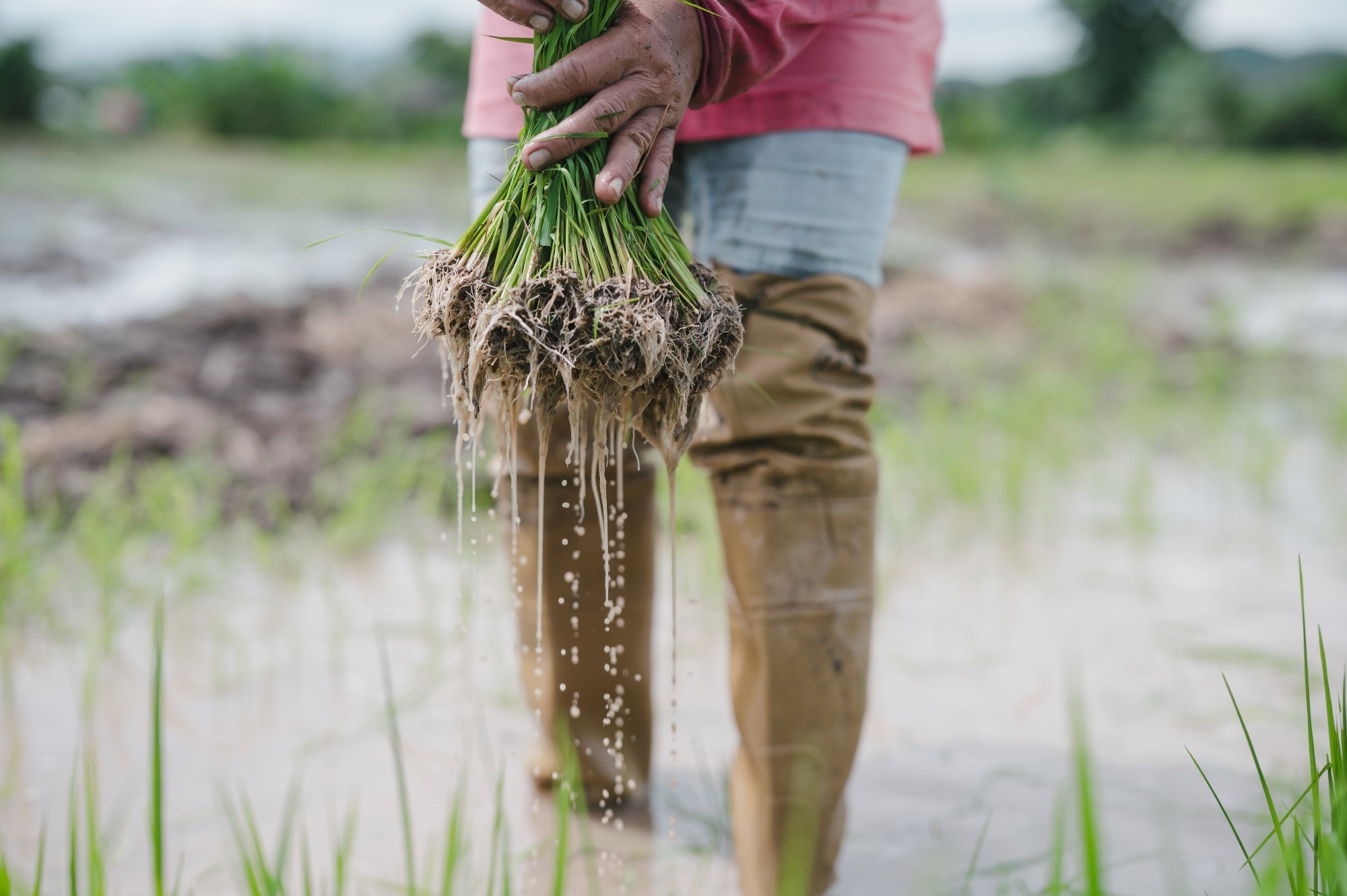
By triggering silver nanoparticle formation inside rice plants, scientists have revealed how nano-biochar actively shapes metal movement in soil, and what that means for food and environmental safety.
 Image Credit: waragon injan/Shutterstock.com
Researchers at Hebei University of Technology have discovered an unexpected new function for nano-biochar, demonstrating its ability to promote the natural creation and buildup of silver nanoparticles within rice roots.
The research, published in Biochar, illustrates how this minuscule carbon substance engages with plant roots to convert silver ions into metallic nanoparticles, which may influence plant health and the transport of metals in the environment.
Silver is used extensively in electronics, medicine, and antimicrobial products, resulting in the discharge of silver ions into soils and water bodies. These ions exhibit high reactivity and may present dangers to living organisms. In contrast, silver nanoparticles are more stable and exhibit lower toxicity. However, the natural formation of these particles in soils has not been well understood.
Led by Shiguo Gu and Fei Lian from Hebei University of Technology, the research team found that nano-biochar functions as an electron shuttle within the rhizosphere, the confined area of soil that encircles plant roots.
When introduced into soil around the rice plants, the nano-biochar particles facilitated the transfer of electrons to the oxygen released from the roots. This mechanism produced superoxide radicals, which subsequently reduced silver ions, resulting in the formation of silver nanoparticles. The presence of the superoxide radicals was confirmed through specialized probe and quenching experiments.
The team used high-resolution microscopy and single-particle ICP-MS to verify that the nanoparticles developed around the roots and accumulated within the rice leaves and cells.
Interestingly, a moderate quantity of nano-biochar facilitated the formation of silver nanoparticles, whereas excessive quantities diminished oxygen secretion from roots and inhibited the process. The team linked this inhibitory effect to excess nano-biochar covering root surfaces and interfering with oxygen release through the aerenchyma tissues.
The researchers also discovered that nano-biochar decreased rice’s overall uptake of toxic silver ions while enabling the accumulation of less toxic nanoparticles in both roots and shoots. This finding indicates that nano-biochar can safeguard plants from toxic metals and affect the movement of metals within the soil-plant system.
Our findings highlight that nano-biochar is not just a passive soil amendment but an active participant in chemical transformations in the rhizosphere. It plays a catalytic role in regulating redox-active metals and could influence how these elements cycle through ecosystems.
Fei Lian, Hebei University of Technology
The research introduces new inquiries regarding the possibility of naturally occurring nanoparticles infiltrating the food chain. At the same time, it presents opportunities to use the reactivity of biochar to enhance soil health and promote sustainable agricultural methods.
The authors propose that comprehending and regulating nano-biochar’s dual impacts, its capacity to detoxify metals while facilitating nanoparticle formation, will be essential to guaranteeing environmental safety and food security.
Journal Reference:
Gu, S., et al. (2025) Insight into the crucial role of nano-biochar in the natural formation and bioaccumulation of silver nanoparticles in the rhizosphere by single-particle ICP-MS. Biochar. doi.org/10.1007/s42773-025-00492-w