
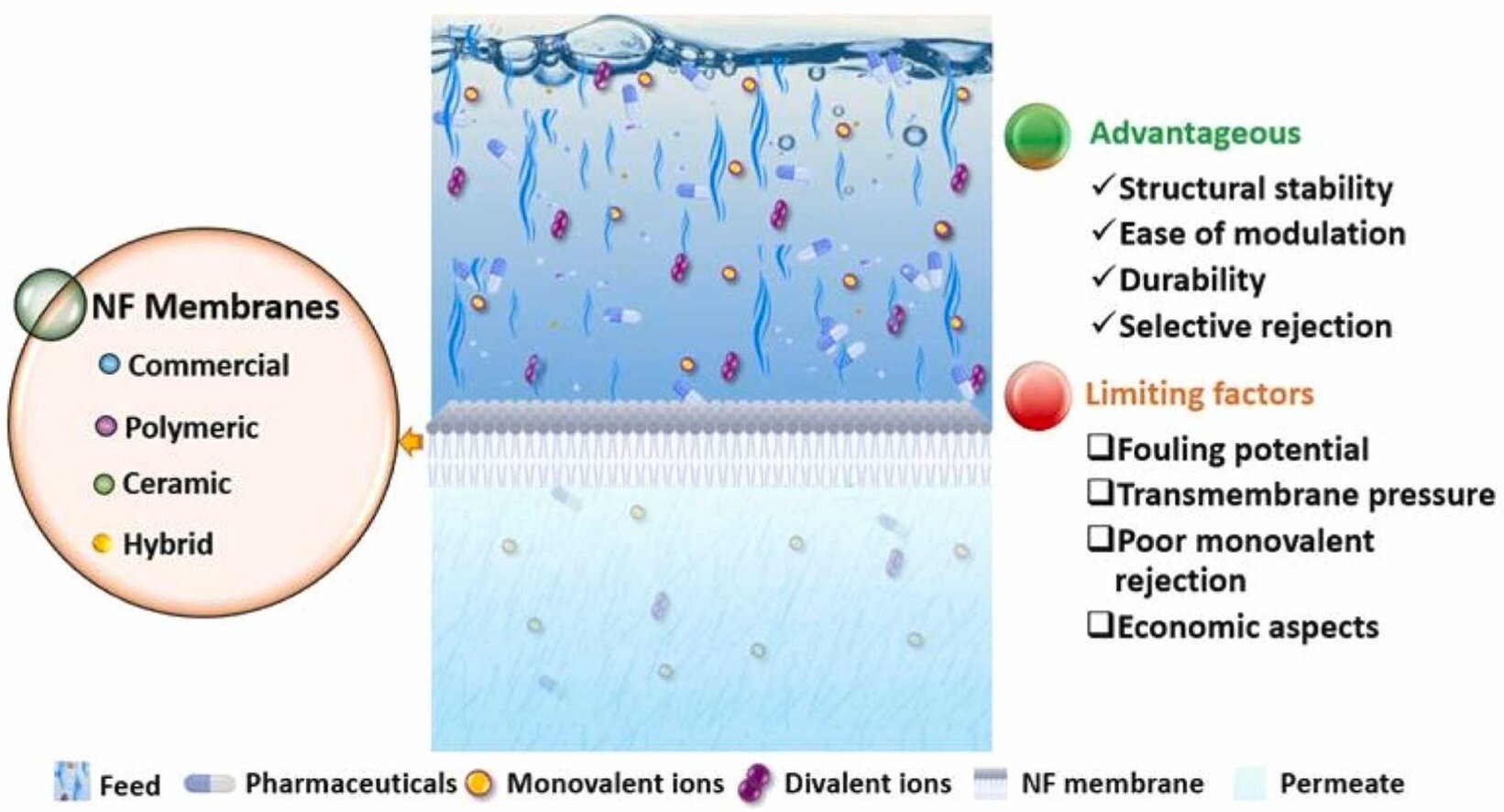
A comprehensive review of scientific literature has identified nanofiltration (NF) membrane technologies as the most effective method for removing pharmaceutical contaminants from water sources, according to researchers from the University of Sharjah.
“The NF membranes show high efficacy in removing a broad spectrum of pharmaceuticals, particularly high-molecular-weight and charged compounds,” the scientists report in the journal Cleaner Water.
NF membranes are pressure-driven filtration systems widely used in removal technologies to extract pollutants like pharmaceuticals from wastewater and water treatment processes. With a pore size of 1 to 10 nanometers, these membranes allow water and small ions to pass through, effectively blocking various pollutants, including residual and unused pharmaceuticals.
The authors’ research involved a systematic search of peer-reviewed journals, government reports, and industry publications. Their target behind the review was to collect as much data as possible to detect the presence of pharmaceuticals in water systems, assess their adverse impact on the environment and human health, and provide a foundation for future risk assessments.
Importantly, the review was not confined to NF membranes. It also evaluated the performance of various membranes in removing pharmaceuticals, including commercial NF membranes, polymeric NF membranes produced through interfacial polymerization and layer-by-layer (LbL) assembly, ceramic NF membranes, and hybrid NF membranes.

“Data on removal efficiencies, fouling tendencies, and operational conditions were extracted from relevant studies to compare the effectiveness of each membrane type,” the researchers explain. They add that the review examined the limitations and challenges associated with each membrane category, including fouling mechanisms, economic feasibility, and scalability for large-scale applications.
“The review also incorporated studies on the socioeconomic aspects and future projections for nanofiltration membranes, providing a comprehensive understanding of their feasibility and sustainability for pharmaceutical removal,” the scientists note.
The authors emphasize that, unlike previous reviews in the field, which predominantly focus on adsorption techniques and general membrane technologies for pharmaceutical removal, their study presents an in-depth analysis of the role of NF membranes specifically. The study also highlights a significant surge in relevant publications between 2014 and 2024.
“This emphasis reflects the rapid expansion of NF applications, particularly in the removal of pharmaceuticals,” they maintain, emphasizing that data shows researchers worldwide are engaged in studies on how to remove contaminants like pharmaceuticals in water sources, and increase awareness of their detrimental effects on ecosystems and human health.
The researchers maintain that NF technologies are experiencing exponential growth as part of the global effort to meet demands for sustainable wastewater treatment processes that can sustainably remove pharmaceutical pollutants.
They stress that innovations such as organic solvent nanofiltration (OSN), surface charge tuning, and the integration of nanomaterials are paving the way for more efficient and adaptable NF systems, offering promising avenues for the treatment of pharmaceutical-laden wastewater.

Organic solvent nanofiltration (OSN), a pressure-driven membrane technology, uses solvent-resistant nanofiltration. The technology is gaining recognition as it is economically viable and has proven to be more environmentally friendly than traditional separation technologies like distillation. “OSN, in particular, has emerged as a viable method for molecular-level purification in solvent-rich environments due to its enhanced solvent stability and selectivity,” the authors stress.
The scientists highlight the significance of academic investigation into NF technologies, particularly in the context of removing pharmaceutical contaminants from wastewater. They underscore that more focused research and intensified efforts are needed and that a higher degree of concentration and considerable effort are required on the part of researchers investigating removal technologies that use various types of membranes.
“For commercial NF membranes, there is a pressing need to assess scalability and performance under real wastewater conditions,” the authors go on. These conditions, they note, often involve “complex mixtures of pharmaceuticals and co-contaminants such as nutrients, organic foulants, heavy metals, PFAS, and microplastics, an area that remains insufficiently explored.”
The authors demonstrate that, unlike other pressure-driven filtration systems, NF membranes can be tailored to effectively treat wastewater contaminated with a wide array of pharmaceutical compounds. However, they say, NF membrane performance is closely tied to several variables, including membrane composition, operational parameters, and the physicochemical properties of the target pollutants.
Of the advanced NF technologies reviewed, the authors apparently advocate for the use of ceramic NF membranes, citing their exceptional thermal and chemical resistance, which makes them particularly suitable for demanding treatment scenarios. However, their adoption is hitherto limited, they add, mainly due to the higher costs involved in their production.
The authors recommend the integration of polymeric NF membranes with enhanced fouling resistance to improve performance.
In contrast, they strongly discourage reliance on conventional wastewater treatment methods, such as coagulation, UV disinfection, and basic biological degradation due to their consistently limited removal efficiencies (<70%) for recalcitrant pharmaceuticals.
More information:
Samy Elhadi Oussadou et al, Nanofiltration membranes for efficient removal of pharmaceuticals from wastewater: A state-of-the-art review, Cleaner Water (2025). DOI: 10.1016/j.clwat.2025.100100
Citation:
Study finds nanofiltration membranes most effective in tackling pharmaceutical pollution (2025, October 13)
retrieved 13 October 2025
from https://phys.org/news/2025-10-nanofiltration-membranes-effective-tackling-pharmaceutical.html
This document is subject to copyright. Apart from any fair dealing for the purpose of private study or research, no
part may be reproduced without the written permission. The content is provided for information purposes only.