
When biomedical researchers need to test their latest ideas, they often turn to engineered human tissue that mimics the responses in our own bodies. It’s become an important intermediary step before human clinical trials.
One limiting factor: The cells need blood circulation to survive, and achieving that can be difficult in three-dimensional cell structures. Without proper vascular systems—even primitive ones—engineered tissue faces restricted size and functionality, even developing necrotic regions of dead cells.
New research from Binghamton University’s Thomas J. Watson College of Engineering and Applied Science offers a possible solution to the problem. In a paper recently published in the journal Biomedical Materials, Assistant Professors Ying Wang and Yingge Zhou show how the latest nanomanufacturing techniques can create a better artificial vascular system.
Also part of the research team were doctoral students Xianyang Li, Sadia Khan and Yan Chen; Liyuan Wang ’23; and postdoctoral researcher Xiang Fang.
“Our vascular system has different hierarchies,” said Ying Wang, a faculty member in the Department of Biomedical Engineering. “We have bigger ones, like our aorta or veins, and smaller arteries for different functions.
“We can 3D print the larger ones, and for the smaller ones we rely on spontaneous self-assembly to organize them. However, we are trying to engineer some biomaterials to be able to regulate the size, to make it bigger or smaller, so we can fabricate different types of vasculature.”
In his previous research, Zhou—from the School of Systems Science and Industrial Engineering—built 3D scaffolding on a microscopic scale.

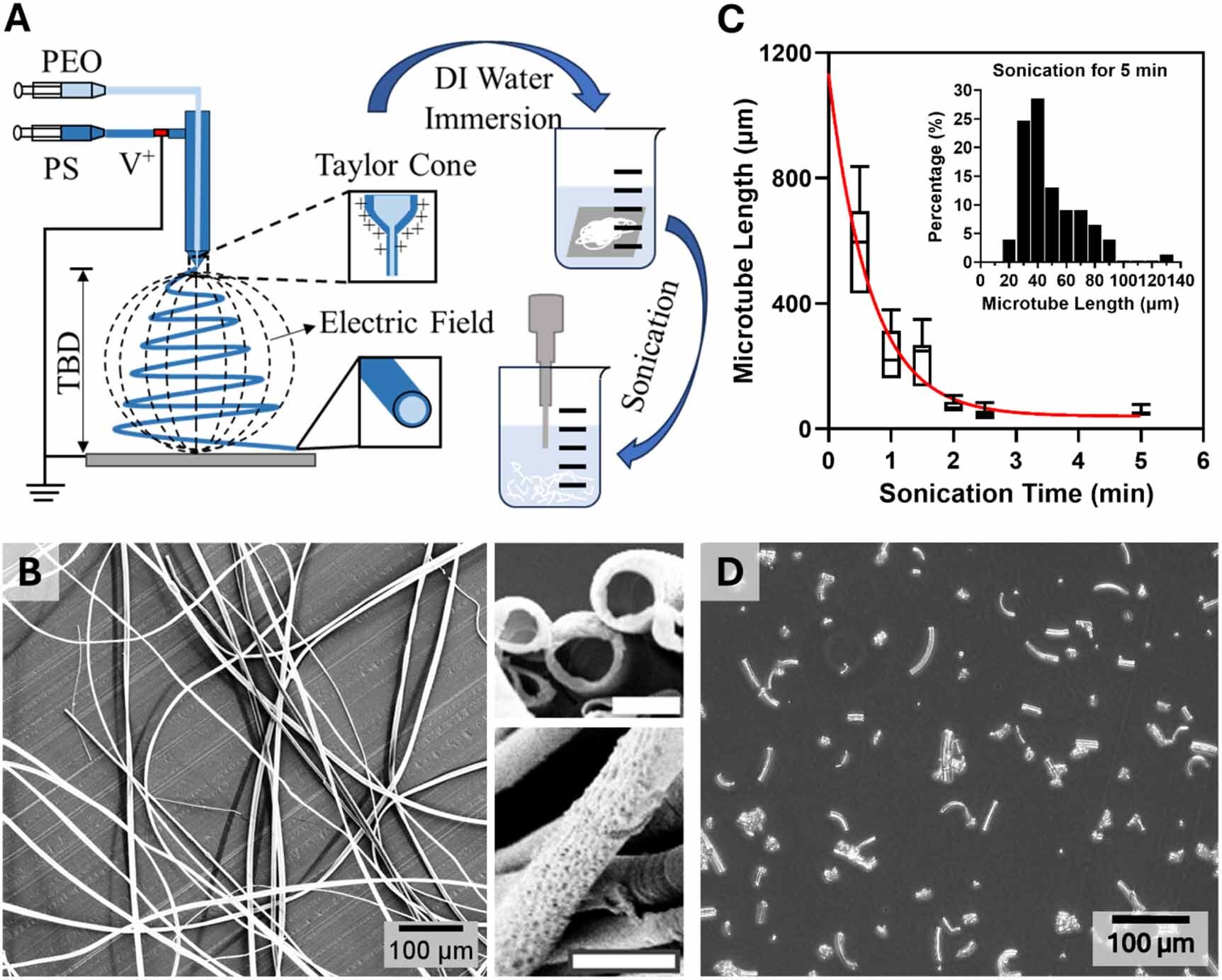
The Binghamton team made microtubes from two inert compounds often used in biomedical devices: polyethylene oxide (PEO) and polystyrene (PS). Electrospinning, a manufacturing technique that uses a strong electric field to form ultra-fine fibers, was essential for creating something at that small scale.
“The microtube is between 1 to 10 microns,” Zhou said. (A micron is one-millionth of a meter; the average human hair is 70–100 microns.) “It’s hard for the 3D printer to print with that kind of resolution, so we used electrospinning to make solid microtubes. Then we dissolved the cores to make them hollow tubes and used ultrasonic vibration to break them down, so they were not too long. We wanted them to be shorter and disperse within the engineered tissue.”
Using fluorescent microbeads, the researchers tracked blood flow in the engineered tissue and found that the tubes improved blood distribution, supplying the nutrition and oxygen that cells need to stay alive.
Looking ahead, they would like to investigate how the dimensions and shape of the microtubes affect vascular outcomes and how the structures can be tuned for specific tissue engineering needs. They also want to develop more organ-specific microvasculature, such as the blood-brain barrier that separates the circulatory system from brain tissue. Understanding that barrier is essential to treating tumors or neurodegenerative diseases.
“We want to bring the physiological relevance of these engineered tissues closer to our own bodies,” Wang said. “If we perfect this technology, we can assemble not only a single organ but multiple organs as a living system based on human cells.”
More information:
Xianyang Li et al, Engineering polystyrene microtube-embedded composite hydrogels for tunable vascular morphogenesis, Biomedical Materials (2025). DOI: 10.1088/1748-605x/adebd0
Citation:
Researchers use nanotubes to improve blood flow in bioengineered tissues (2025, September 29)
retrieved 30 September 2025
from https://phys.org/news/2025-09-nanotubes-blood-bioengineered-tissues.html
This document is subject to copyright. Apart from any fair dealing for the purpose of private study or research, no
part may be reproduced without the written permission. The content is provided for information purposes only.