
A research team led by the California NanoSystems Institute at UCLA, or CNSI, demonstrated a new type of light-emitting material expected to be suitable for photonics—devices based on light in the same way that today’s electronics are based on electrical signals.
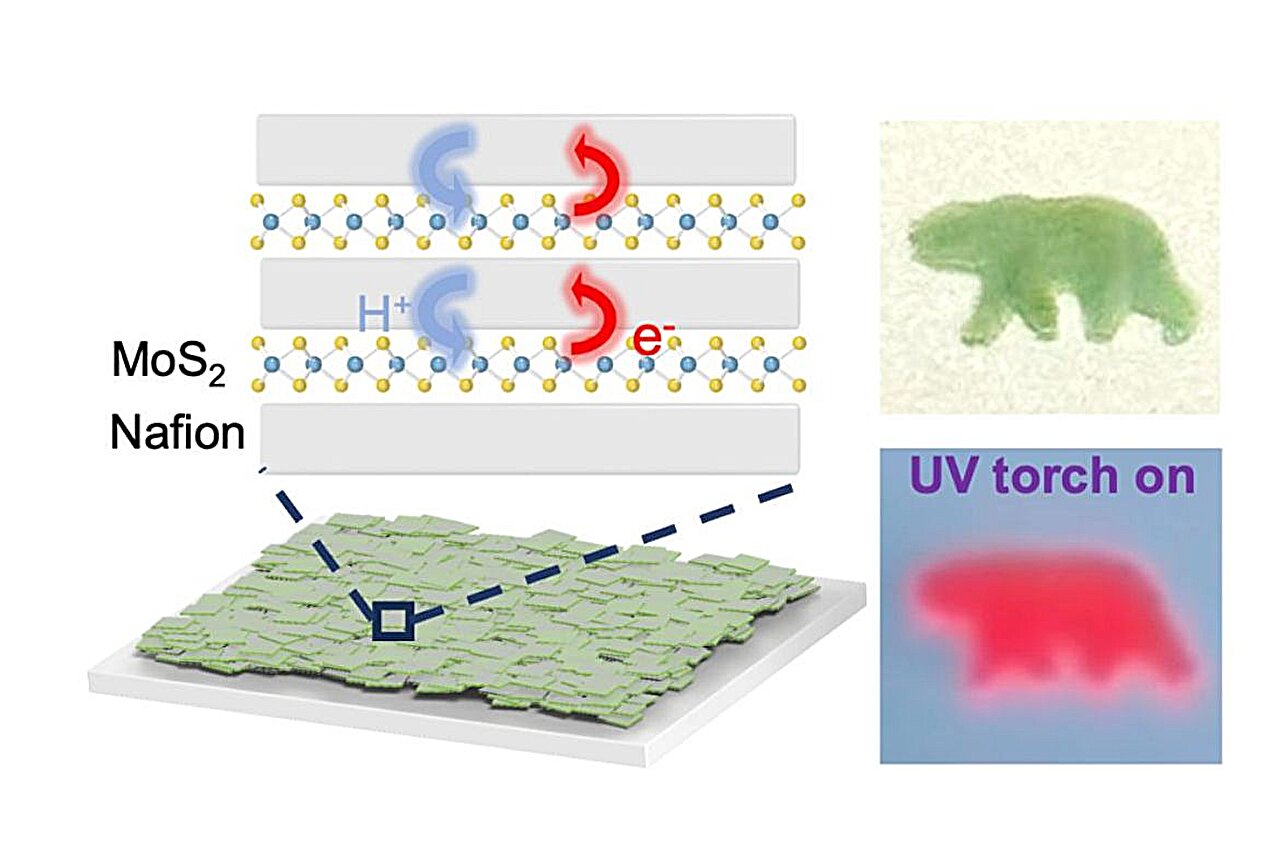
The team used a semiconductor called molybdenum disulfide, in the form of a so-called “two-dimensional material” only three atoms thick, and Nafion, a polymer used in fuel cells.
The study is published in the Journal of the American Chemical Society.
The result was a printable, large-area, stretchable membrane that emitted bright light. Because it is durable and inexpensive to produce, the material holds great potential for chip-integrated light sources for photonic computation.
The innate properties of light enable photonic technologies to work faster and use energy more efficiently than traditional electronics. Current uses for photonics include lasers, fiber-optic telecommunications, solar cells and smartphone cameras, scanners and displays.
The development of future photonic computing could vastly expand upon the capabilities seen in today’s electronic computers. While there are limits to how conventional semiconductors can be integrated on a chip, molybdenum disulfide and other 2D materials offer a path toward ultrathin, flexible components that can be built directly into photonic circuits.
However, adapting 2D molybdenum disulfide for photonics has been challenging to date. On their own, the ultrathin layers are extremely delicate and yield very little light. The new UCLA-developed material overcomes these limitations because Nafion reinforces the fragile 2D layer and heals defects in its surface, achieving orders of magnitude greater light-emitting efficiency.
UCLA’s research group is unusually multidisciplinary. Whereas most groups working on Nafion come from the energy community—fuel cells, batteries and catalysis—and researchers in 2D semiconductors tend not to engage with ionomer chemistry, UCLA’s energy and 2D optoelectronics subgroup constantly exchange ideas about materials processing.
That overlap sparked the idea of combining two “common” materials from different worlds—Nafion and MoS2—and the unexpected synergy made the breakthrough possible.
The researchers stacked alternating layers of 2D molybdenum sulfide and Nafion, which is seldom paired with 2D materials. This design preserved the ideal behavior of the 2D layer, even in thick, flexible membranes. The usually fragile material was then deployed in large-area membranes that were markedly brighter and remained stable in air, in water and when stretched.
The material in the study may create new possibilities for photonic technologies. Future computers encoding information and conducting calculations with light could provide new levels of processing speed, while mitigating the extremely high energy cost of popular applications such as generative artificial intelligence.
In the shorter term, the researchers plan to use the new material in compact, flexible, stretchable displays, as components in computer chips and in lasers.
The study’s corresponding author is CNSI member Xiangfeng Duan, holder of the Raymond A. and Dorothy A. Wilson Endowed Chair and a distinguished professor of chemistry and biochemistry at the UCLA College. The first author is Boxuan Zhou, a UCLA doctoral student.
More information:
Boxuan Zhou et al, Solid-State Ionomer-Interlayered Bulk Monolayer MoS2 Membranes with Thickness-Scalable Bright Luminescence, Journal of the American Chemical Society (2025). DOI: 10.1021/jacs.5c08388
Citation:
Stretchable light-emitting material holds promise for photon-based devices (2025, September 26)
retrieved 26 September 2025
from https://phys.org/news/2025-09-stretchable-emitting-material-photon-based.html
This document is subject to copyright. Apart from any fair dealing for the purpose of private study or research, no
part may be reproduced without the written permission. The content is provided for information purposes only.