
Close Menu
  • News
    • Medical
    • Nanomaterials
    • AI & Robotics
    • 2D Materials
    • Metamaterials
    • Nanoelectronics
    • ETF’s
    • Medicine
  • Environment
    • Earth.com
    • TreeHugger
    • Nanomuscle
  • Beauty
    • Makeupanalysis
What's Hot

Nanotechnology Plus Medicine Equal NanoMedicine

February 3, 2026

Improving PPE’s Antimicrobial Efficacy with ZnO Nanoparticles

December 5, 2025

PI Introduces Next-Generation 6-Axis Nanopositioning Alignment System

December 4, 2025
Facebook X (Twitter) Instagram
  • Contact Us
  • Privacy Policy
  • Terms & Conditions
Facebook X (Twitter) Instagram
Elnano – Global Innovative Nanotechnology SolutionsElnano – Global Innovative Nanotechnology Solutions
  • News
    • Medical
    • Nanomaterials
    • AI & Robotics
    • 2D Materials
    • Metamaterials
    • Nanoelectronics
    • ETF’s
    • Medicine
  • Environment
    • Earth.com
    • TreeHugger
    • Nanomuscle
  • Beauty
    • Makeupanalysis
Elnano – Global Innovative Nanotechnology SolutionsElnano – Global Innovative Nanotechnology Solutions
Home » Ultra-strong coating resists bacteria and viruses on complex organic surfaces
Nanotech

Ultra-strong coating resists bacteria and viruses on complex organic surfaces

September 24, 2025No Comments3 Mins Read
Share
Facebook Twitter LinkedIn Pinterest Email
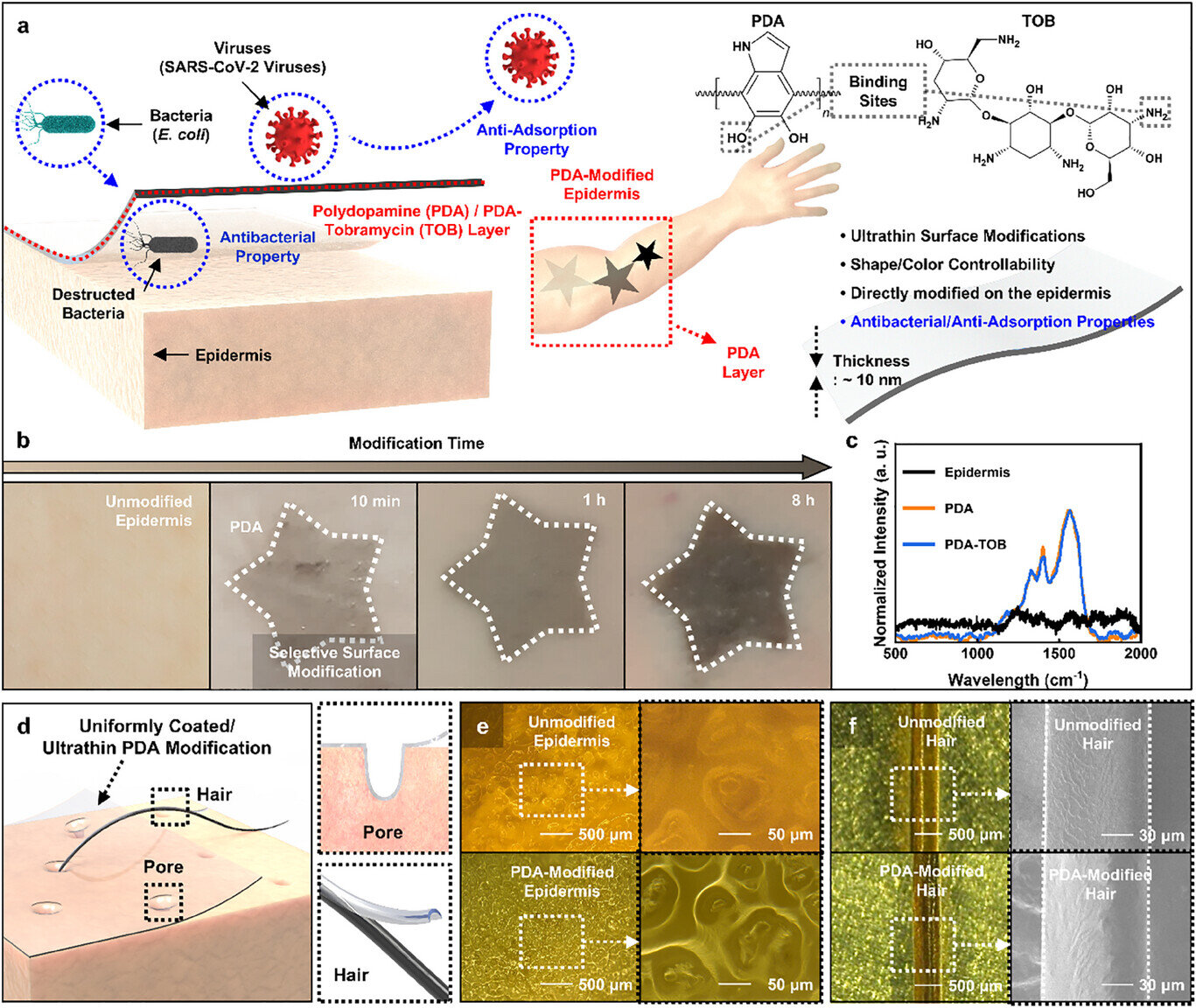
a) Schematic of the direct surface modification of the epidermis using an ultrathin PDA and PDA-TOB layer and its functionalities and binding sites. b) Localized PDA-modified epidermal modification using different polymerization times. c) Raman spectra of bare and PDA- and PDA-TOB-modified epidermises. d) Schematic of an ultrathin PDA layer uniformly coated on pores and hairs. e) Optical microscopy images of unmodified and PDA-modified epidermises with pores. f) Optical (left) and scanning electron (right) microscopy images of unmodified and PDA-modified hairs. Credit: Advanced Healthcare Materials (2025). DOI: 10.1002/adhm.202500597

Professor Bonghoon Kim of the Department of Robotics and Mechatronics Engineering at the Daegu Gyeongbuk Institute of Science & Technology has successfully developed a next-generation surface modification technology with antibacterial and antiviral contamination properties.

The study was conducted in collaboration with Professor Junkyun Oh of the Department of Polymer System Engineering at Dankook University, Senior Researcher Hojun Kim of the Center for Advanced Biomolecular Recognition at the Korea Institute of Science and Technology (KIST), and Professor Janghwan Kim of the Department of Advanced New Materials Engineering at Ajou University. It was featured as a cover article in the journal Advanced Healthcare Materials.

A notable characteristic of this novel surface modification technology developed in this study is its ability to uniformly form nanometer-thick polydopamine (PDA) layers on a wide range of organic surfaces. This technology enables uniform coating for complex surfaces with curved or microscopic pores, thereby minimizing electrical signal fluctuations caused by bodily secretions and enhancing the stability of bio-signal measurements.

While maximizing the bactericidal effect, the PDA layer, combined with the antibiotic tobramycin, inhibits the adsorption of coronavirus on the skin surface, demonstrating its potential for application as medical patches and wearable sensors.

The surface modification method effectively eliminates the need to use toxic solvents and a vacuum environment, key limitations of conventional chemical vapor deposition and self-assembled single molecular membrane processes.

PDA-based coatings formed rapidly and safely in aqueous solution, and performed equally well on substrates with varying degrees of surface energy and roughness, including skin, fruit peels, and animal tissue. This technology’s broad applicability indicates strong potential for future scalability across diverse sectors, including anti-infection materials, vital sign measurement devices, and the cosmetics and beauty industries.

See also  Explore PI’s Precision Motion Innovations for Life Sciences at Neuroscience 2025

“This study holds significance as it was featured as the cover article in a prestigious international journal,” said Professor Bonghoon Kim. “We will continue to examine how antibacterial and anti-contamination functions can be applied in the health care and wearable electronic device sectors in the future.”

More information:
Su Eon Lee et al, Direct Surface Modification of the Epidermis Using Mussel‐Inspired Polydopamine with Multiple Anti‐Biofouling Functions, Advanced Healthcare Materials (2025). DOI: 10.1002/adhm.202500597

Provided by
Daegu Gyeongbuk Institute of Science and Technology


Citation:
Ultra-strong coating resists bacteria and viruses on complex organic surfaces (2025, September 23)
retrieved 24 September 2025
from https://phys.org/news/2025-09-ultra-strong-coating-resists-bacteria.html

This document is subject to copyright. Apart from any fair dealing for the purpose of private study or research, no
part may be reproduced without the written permission. The content is provided for information purposes only.


Source link

bacteria coating Complex Organic resists surfaces ultrastrong viruses
Share. Facebook Twitter Pinterest LinkedIn Tumblr Email

Related Posts

Improving PPE’s Antimicrobial Efficacy with ZnO Nanoparticles

December 5, 2025

PI Introduces Next-Generation 6-Axis Nanopositioning Alignment System

December 4, 2025

H.E. Máté Pesti’s Visit to Cubic Sensor and Instrument Co.

December 2, 2025

Nanostars Amplify SERS Signal and Boost Sensing

December 1, 2025
Add A Comment

Comments are closed.

Top Posts

First graphene-based solar cells used to power temperature sensors

November 13, 2025

Synthetic diamonds created under ambient pressure

September 19, 2025

Lasers and gold nanoparticles enable on-demand crystal growth for new materials

October 15, 2025

Subscribe to Updates

Get the latest sports news from SportsSite about soccer, football and tennis.

Explore the future with our Nanotech blog—covering innovations, research, applications, and breakthroughs shaping science, medicine, and modern technology.

We're social. Connect with us:

Facebook X (Twitter) Instagram YouTube
Top Insights

Nanotechnology Plus Medicine Equal NanoMedicine

February 3, 2026

Improving PPE’s Antimicrobial Efficacy with ZnO Nanoparticles

December 5, 2025

PI Introduces Next-Generation 6-Axis Nanopositioning Alignment System

December 4, 2025

Subscribe to Updates

Get the latest creative news from FooBar about art, design and business.

  • Contact Us
  • Privacy Policy
  • Terms & Conditions

© 2026 elnano.com - All rights reserved.

Type above and press Enter to search. Press Esc to cancel.