
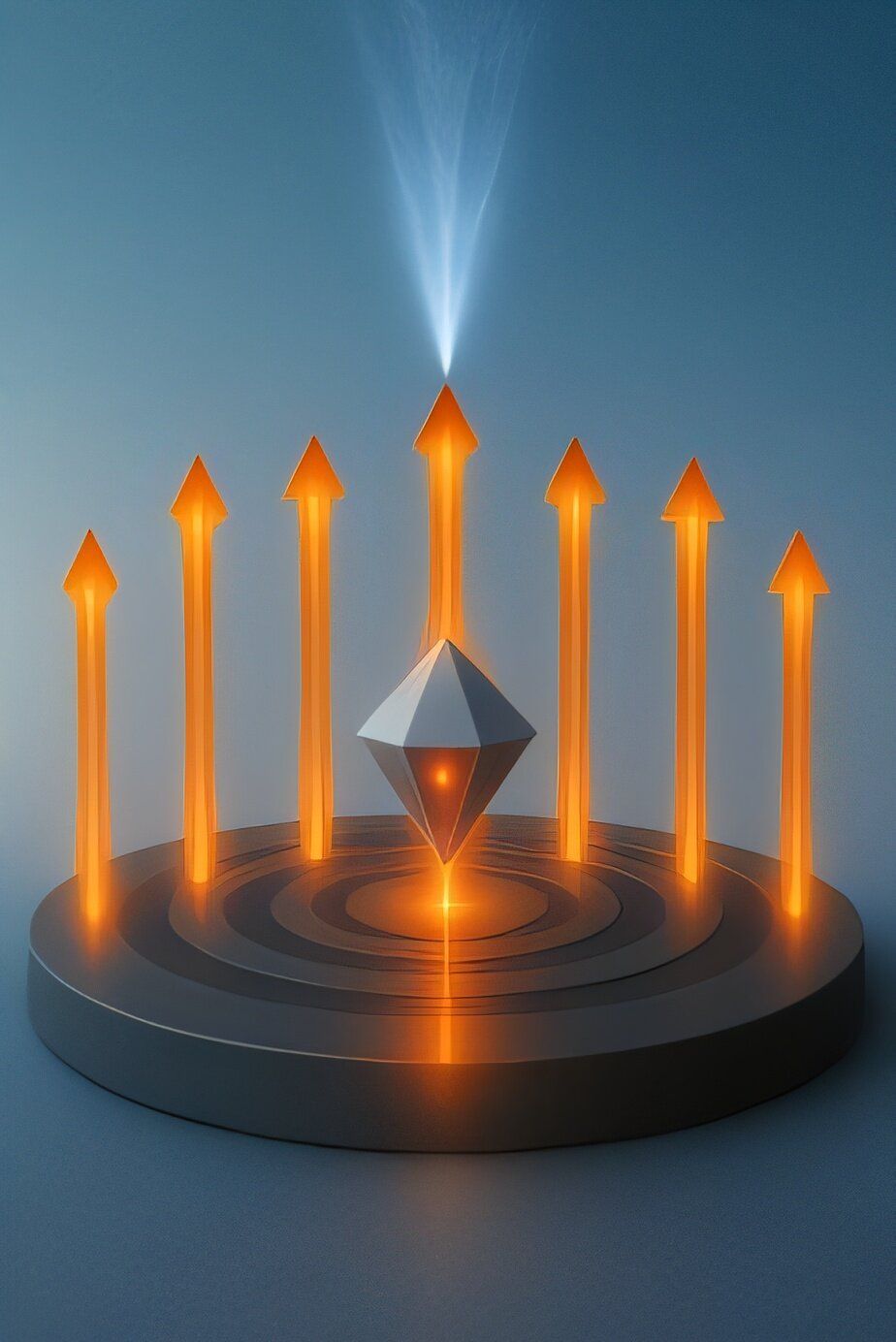
Researchers at the Hebrew University of Jerusalem and the Humboldt University in Berlin have developed a way to capture nearly all the light emitted from tiny diamond defects known as color centers. By placing nanodiamonds into specially designed hybrid nanoantennas with extreme precision, the team achieved record photon collection at room temperature—a necessary step for quantum technologies such as quantum sensors, and quantum-secured communications.
Diamonds have long been prized for their sparkle, but researchers at the Hebrew University of Jerusalem, in collaboration with colleagues from the Humboldt University in Berlin, are showing they achieve an almost optimal “sparkling,” a key requirement for using diamonds also for quantum technology. The team has approached an almost perfect collection of the faintest light signals, single photons, from tiny diamond defects, known as nitrogen-vacancy (NV) centers, which are vital for developing next-generation quantum computers, sensors, and communication networks.
NV centers are microscopic imperfections in the diamond structure that can act like quantum “light switches.” They emit single particles of light (photons) that carry quantum information. The problem, until now, has been that much of this light is lost in all directions, making it hard to capture and use.
The Hebrew University team, together with their research partners from Berlin, solved this challenge by embedding nanodiamonds containing NV centers into specially designed hybrid nanoantennas. These antennas, built from layers of metal and dielectric materials in a precise bullseye pattern, guide the light in a well-defined direction instead of letting it scatter. Using ultra-precise positioning, the researchers placed the nanodiamonds exactly at the antenna center—within a few billionths of a meter.
Featured in APL Quantum, the results are significant: the new system can collect up to 80% of the emitted photons at room temperature. This is a dramatic improvement compared to previous attempts, where only a small fraction of the light was usable.
Prof. Rapaport explained, “Our approach brings us much closer to practical quantum devices. By making photon collection more efficient, we’re opening the door to technologies such as secure quantum communication and ultra-sensitive sensors.”
Dr. Lubotzky added, “What excites us is that this works in a simple, chip-based design and at room temperature. That means it can be integrated into real-world systems much more easily than before.”
The research demonstrates not just clever engineering, but also the potential of diamonds beyond jewelry. With quantum technologies racing toward real-world applications, this advance could help pave the way for faster, more reliable quantum networks.
More information:
Boaz Lubotzky et al, Approaching unity photon collection from NV centers via ultra-precise positioning of nanodiamonds in hybrid nanoantennas, APL Quantum (2025). DOI: 10.1063/5.0272913
Citation:
Hybrid nanoantennas enable light capture from diamond defects (2025, September 18)
retrieved 21 September 2025
from https://phys.org/news/2025-09-hybrid-nanoantennas-enable-capture-diamond.html
This document is subject to copyright. Apart from any fair dealing for the purpose of private study or research, no
part may be reproduced without the written permission. The content is provided for information purposes only.