
Close Menu
  • News
    • Medical
    • Nanomaterials
    • AI & Robotics
    • 2D Materials
    • Metamaterials
    • Nanoelectronics
    • ETF’s
    • Medicine
  • Environment
    • Earth.com
    • TreeHugger
    • Nanomuscle
  • Beauty
    • Makeupanalysis
What's Hot

Nanotechnology Plus Medicine Equal NanoMedicine

February 3, 2026

Improving PPE’s Antimicrobial Efficacy with ZnO Nanoparticles

December 5, 2025

PI Introduces Next-Generation 6-Axis Nanopositioning Alignment System

December 4, 2025
Facebook X (Twitter) Instagram
  • Contact Us
  • Privacy Policy
  • Terms & Conditions
Facebook X (Twitter) Instagram
Elnano – Global Innovative Nanotechnology SolutionsElnano – Global Innovative Nanotechnology Solutions
  • News
    • Medical
    • Nanomaterials
    • AI & Robotics
    • 2D Materials
    • Metamaterials
    • Nanoelectronics
    • ETF’s
    • Medicine
  • Environment
    • Earth.com
    • TreeHugger
    • Nanomuscle
  • Beauty
    • Makeupanalysis
Elnano – Global Innovative Nanotechnology SolutionsElnano – Global Innovative Nanotechnology Solutions
Home » Scientists build motors narrower than a human hair
Nanotech

Scientists build motors narrower than a human hair

September 21, 2025No Comments3 Mins Read
Share
Facebook Twitter LinkedIn Pinterest Email


Scientists build motors narrower than a human hair

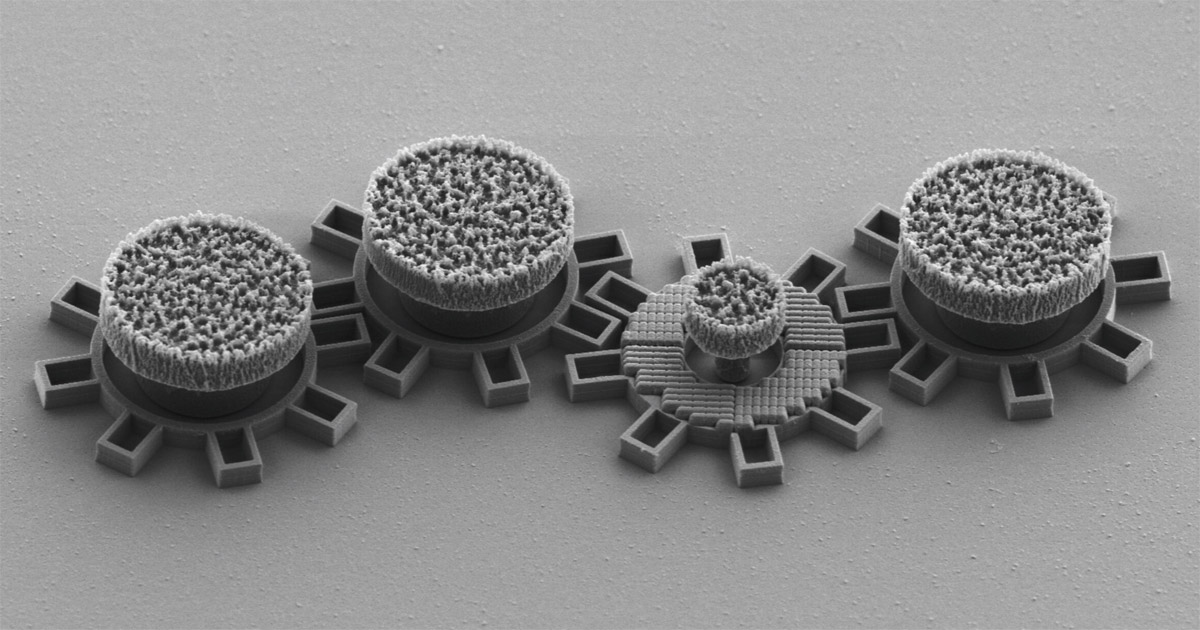
Researchers in Sweden have built laser-driven gears just 16 micrometres wide – about a tenth the width of a human hair – paving the way for medical tools that operate at the scale of individual cells.


Researchers at the University of Gothenburg in Sweden have developed the smallest on-chip motors ever created – light-powered gears on a micrometre scale. These micromotors could one day work alongside living cells.

Gears are everywhere, from clocks and cars to robots and wind turbines. For more than three decades, scientists have tried to shrink them ever further to construct micro-engines. Yet until now, efforts stalled at around 0.1 millimetres, because mechanical drive trains could not be made any smaller.

The Gothenburg team has now overcome this size barrier by discarding traditional mechanics and instead using laser light to drive the gears directly. Their study shows that optical metamaterials – tiny, patterned structures able to capture and control light – can spin gears just 16 micrometres wide. That is one-sixth the size of previous attempts, and makes them smaller than many human cells.

Using lithography, the researchers fabricated gears with metamaterials in silicon directly on a microchip. When struck by a laser, the gears rotate. The light’s intensity controls the speed, while its polarisation determines the direction.


“We have built a gear train in which a light-driven gear sets the entire chain in motion,” explains Gan Wang, first author and a researcher in soft matter physics. “The gears can also convert rotation into linear motion, perform periodic movements and control microscopic mirrors to deflect light.”

See also  AI optical microscope analyzes 2D materials as precisely as human experts

The ability to integrate such machines directly onto a chip and drive them with light opens up entirely new possibilities, according to the team. Since laser light does not require any fixed contact with the machine and is easy to control, the micromotor can be scaled up to complex microsystems.

“This is a fundamentally new way of thinking about mechanics on a microscale. By replacing bulky couplings with light, we can finally overcome the size barrier,” adds Wang.

With advances such as this, researchers are beginning to imagine light-sensitive micro- and nanomachines that can manipulate small particles, or be integrated into future lab-on-a-chip systems. Medicine is a particularly promising field. With gears as small as human cells, micromotors could pump fluids, regulate flows inside the body, or function as tiny valves that open and close on demand.

This breakthrough brings science a step closer to machines that operate seamlessly at cellular scales, with potential to transform diagnostics, treatment and biomedical research.


Comments »


If you enjoyed this article, please consider sharing it:


Source link

build hair Human motors narrower Scientists
Share. Facebook Twitter Pinterest LinkedIn Tumblr Email

Related Posts

Improving PPE’s Antimicrobial Efficacy with ZnO Nanoparticles

December 5, 2025

PI Introduces Next-Generation 6-Axis Nanopositioning Alignment System

December 4, 2025

H.E. Máté Pesti’s Visit to Cubic Sensor and Instrument Co.

December 2, 2025

Nanostars Amplify SERS Signal and Boost Sensing

December 1, 2025
Add A Comment

Comments are closed.

Top Posts

Silver-nanoring coating points to ‘self-regulating’ smart windows—without power or tinting

October 3, 2025

Sugar-Coated Nanoparticles Boost Cancer Drug Efficacy

September 18, 2025

New Breakthrough Could Bring Holograms to Your Phone

September 18, 2025

Subscribe to Updates

Get the latest sports news from SportsSite about soccer, football and tennis.

Explore the future with our Nanotech blog—covering innovations, research, applications, and breakthroughs shaping science, medicine, and modern technology.

We're social. Connect with us:

Facebook X (Twitter) Instagram YouTube
Top Insights

Nanotechnology Plus Medicine Equal NanoMedicine

February 3, 2026

Improving PPE’s Antimicrobial Efficacy with ZnO Nanoparticles

December 5, 2025

PI Introduces Next-Generation 6-Axis Nanopositioning Alignment System

December 4, 2025

Subscribe to Updates

Get the latest creative news from FooBar about art, design and business.

  • Contact Us
  • Privacy Policy
  • Terms & Conditions

© 2026 elnano.com - All rights reserved.

Type above and press Enter to search. Press Esc to cancel.