
DNA can now be stored for billions of years
Scientists have stored a full human genome on a 5D memory crystal, paving the way for eternal data archiving and potential restoration of species in the distant future.
DNA, the software code for biological life, degrades relatively quickly in the wild when measured on geological timescales. While the exact rate of information loss can vary – depending on environmental factors such as temperature, pH levels, and exposure to light – the half-life of DNA is 521 years. This means that every 1,000 years, 75% of the remaining genetic information is lost.
Even if stored in pristine conditions at –5°C, every molecular bond in a strand of DNA will have broken after 6.8 million years. However, researchers have been developing a revolutionary data storage format that could now preserve genetic information for billions of years.
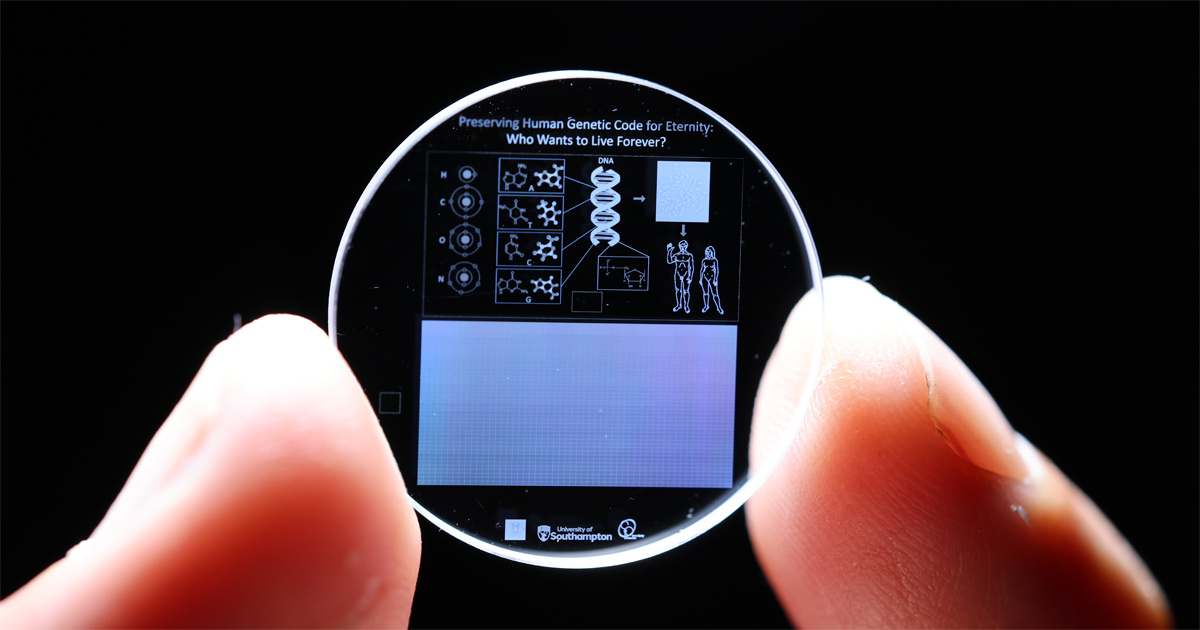
Scientists at the University of Southampton’s Optoelectronics Research Centre (ORC) have successfully stored the full human genome on a “5D” memory crystal – an everlasting data storage medium that could survive the human race itself. This groundbreaking technology utilises nanostructured glass and femtosecond laser writing to encode data in five dimensions, offering unprecedented storage capacity and longevity.
Coined as the “eternity crystal,” the 5D memory device can store up to 360 terabytes of information on a single tiny disc, with thermal stability up to 1,000°C and virtually unlimited lifetime at room temperature. Unlike traditional data storage formats that degrade over time, this crystal is equivalent to fused quartz, one of the most chemically and thermally durable materials on Earth. In addition to high and low temperature extremes, it can withstand direct impact forces of up to 10 tons per cm², and prolonged exposure to cosmic radiation.
The data is recorded via self-assembled nanostructures created in silica, using ultrafast lasers to produce extremely short and intense pulses of light. This method encodes information in five dimensions: the size and orientation of the nanostructures, in addition to their three-dimensional position in the crystal. Feature sizes are as small as 20 nanometres.
Researchers have previously used this 5D memory technique to encode a 300 kb text file (2013) and historical documents (2016), demonstrating the potential of this technology for long-term data preservation. Their latest breakthrough builds upon these earlier successes, with the team now storing the full human genome on a single crystal.
“The 5D memory crystal opens up possibilities for other researchers to build an everlasting repository of genomic information, from which complex organisms like plants and animals might be restored should science in the future allow,” said Professor Peter Kazansky, who leads the team at the ORC.
By archiving a full human genome on one of these crystals, there is now a potential blueprint to bring humanity back from extinction thousands, millions, or even billions of years into the future. The creation of an entirely synthetic human – using genetic information alone – is beyond the realms of current technology. However, recent advances in the field, such as the creation of a synthetic bacterium in 2010, suggest it could become feasible in the far future.
Kazansky’s team partnered with Helixworks Technologies to encode the approximately three billion letters, consisting of one of four bases (G, A, C, or T), of the human genome onto a crystal. Each letter was sequenced 150 times to ensure accuracy.
In designing the crystal, the researchers considered the possibility that it might be retrieved by an intelligence – whether a species or machine – that comes after humans in the distant future. To aid in data retrieval, they inscribed a visual key onto the crystal, providing information about the data stored within and how it could be used. This includes representations of the universal elements (hydrogen, oxygen, carbon, and nitrogen), the four bases of DNA (adenine, cytosine, guanine, and thymine) with their molecular structures, and the arrangement of genes into chromosomes.
For a visual indication of which species the 5D memory crystal relates to, the team paid homage to the Pioneer spacecraft plaques launched by NASA, which carry information about humanity into space. “We don’t know if memory crystal technology will ever follow these plaques in distance travelled, but each disc can be expected with a high degree of confidence to exceed their survival time,” adds Professor Kazansky.
The crystal is now being stored in the Memory of Mankind (pictured below) – a special time capsule within a salt cave in Hallstatt, Austria – ensuring its preservation for as long as possible.
This breakthrough has significant implications, not only for archiving human genetic information but also for preserving the genomes of endangered plant and animal species. As an extremely stable and safe form of portable memory, the devices could be incredibly useful for organisations such as national archives, libraries, and museums.
Comments »
If you enjoyed this article, please consider sharing it: