
Close Menu
  • News
    • Medical
    • Nanomaterials
    • AI & Robotics
    • 2D Materials
    • Metamaterials
    • Nanoelectronics
    • ETF’s
    • Medicine
  • Environment
    • Earth.com
    • TreeHugger
    • Nanomuscle
  • Beauty
    • Makeupanalysis
What's Hot

Nanotechnology Plus Medicine Equal NanoMedicine

February 3, 2026

Improving PPE’s Antimicrobial Efficacy with ZnO Nanoparticles

December 5, 2025

PI Introduces Next-Generation 6-Axis Nanopositioning Alignment System

December 4, 2025
Facebook X (Twitter) Instagram
  • Contact Us
  • Privacy Policy
  • Terms & Conditions
Facebook X (Twitter) Instagram
Elnano – Global Innovative Nanotechnology SolutionsElnano – Global Innovative Nanotechnology Solutions
  • News
    • Medical
    • Nanomaterials
    • AI & Robotics
    • 2D Materials
    • Metamaterials
    • Nanoelectronics
    • ETF’s
    • Medicine
  • Environment
    • Earth.com
    • TreeHugger
    • Nanomuscle
  • Beauty
    • Makeupanalysis
Elnano – Global Innovative Nanotechnology SolutionsElnano – Global Innovative Nanotechnology Solutions
Home » Zero-index metamaterials and the future
Metamaterials

Zero-index metamaterials and the future

September 19, 2025No Comments3 Mins Read
Share
Facebook Twitter LinkedIn Pinterest Email
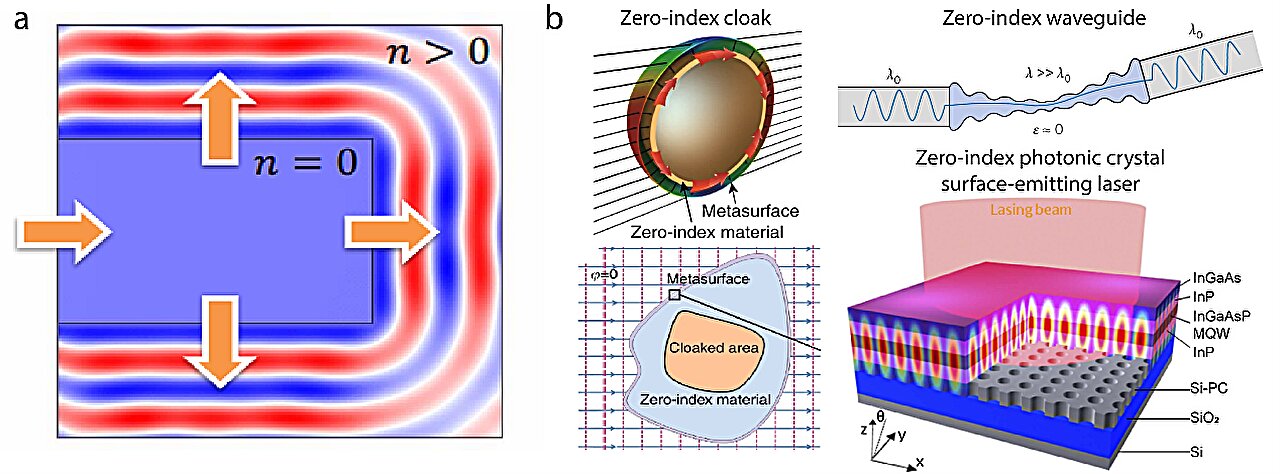
Fig. 1. (a) Ideal homogenous zero-index medium. (b) Zero-index medium’s applications in free-space cloak, arbitrarily shaped waveguide, and photonic crystal surface emitting laser. Credit: eLight (2024). DOI: 10.1186/s43593-023-00059-x

In the realm of materials science, electromagnetic (EM) metamaterials have emerged as a revolutionary class of engineered composites capable of manipulating electromagnetic waves in ways never before possible. Unlike their naturally occurring counterparts, EM metamaterials derive their extraordinary properties from their unique structural arrangements, allowing them to exhibit unattainable electromagnetic characteristics in conventional materials.

One of the most fascinating characteristics of EM metamaterials lies in the realm of zero-index metamaterials (ZIMs). ZIMs possess the remarkable ability to achieve uniform electromagnetic field distribution over arbitrary shape (Figure 1a). This unique property opens many potential applications, from ultra-compact cloaking devices to arbitrarily shaped waveguides and lenses and photonic crystal surface-emitting lasers (Figure 1b).

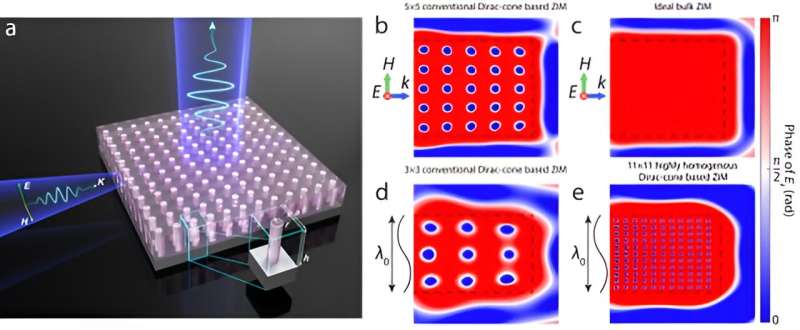
Despite their immense potential, ZIMs have faced a significant hurdle in their practical implementation. The homogeneity of ZIMs is often limited by the number of unit cells per free-space wavelength. This limitation arises from the low permittivities property of the materials used to construct ZIMs. As a result, ZIMs often require large physical space to achieve their effective electromagnetic properties (Figure 2b).
Zero-index metamaterials and the future
Fig. 2. (a) Schematic of Dirac-cone based ZIM. (b) 5×5 conventional Dirac-cone based ZIM. (c) Ideal bulk ZIM. (d) 3×3 conventional Dirac-cone based ZIM. (e) 11×11 highly homogeneous Dirac-cone based ZIM. Credit: eLight (2024). DOI: 10.1186/s43593-023-00059-x

Researchers have overcome this longstanding challenge in a study published in eLight by developing a highly homogeneous ZIM using a novel combination of high-permittivity materials.

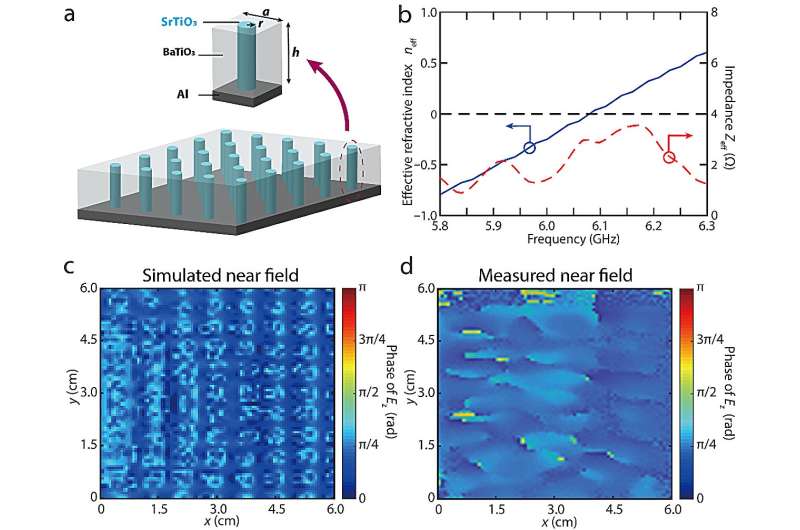
As shown in Figure 3a, by employing SrTiO3 ceramic pillars embedded in a BaTiO3 background matrix, they have successfully fabricated a ZIM with an over threefold increase in homogenization level (Figures 2b and 2e), significantly reducing its physical dimensions.
Zero-index metamaterials and the future
Fig. 3. (a) Schematic of the highly homogeneous ZIM. (b) Simulated effective refractive index and impedance of the highly homogeneous ZIM. (c, d) Simulated and measured near-field distributions over the top surface of the ZIM. Credit: eLight (2024). DOI: 10.1186/s43593-023-00059-x

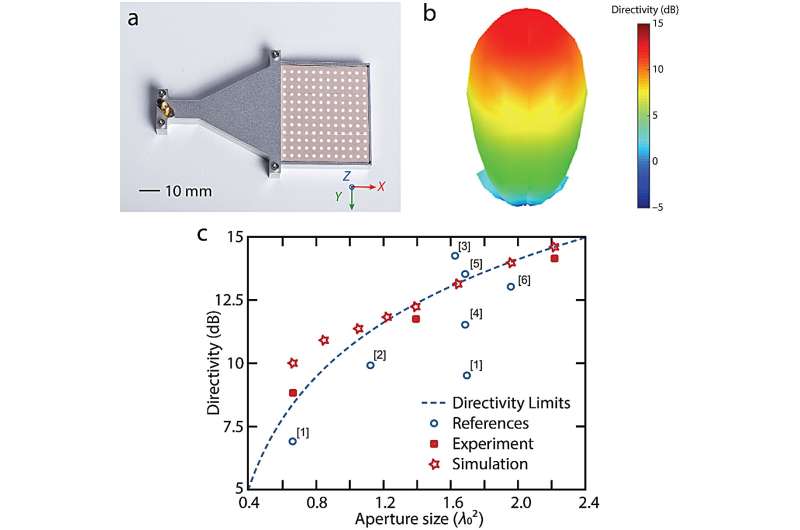
Based on the uniform distribution of the phase of electromagnetic field throughout the ZIM, researchers have demonstrated a high-directivity antenna. By incorporating ZIM in a metallic waveguide (Figure 4a), this antenna has approached the fundamental limitation of directivity in antenna as the aperture size varies from subwavelength regime to a very large scale (Figure 4c).
Zero-index metamaterials and the future
Fig. 4. (a) Photograph of the ZIM-based antenna. (b) Simulated far-field directivity pattern of the ZIM-based antenna. (c) Comparison of simulated and measured directivities of ZIM-based antennas and those of dielectric antennas with the calculated directivity limits. Credit: eLight (2024). DOI: 10.1186/s43593-023-00059-x

This breakthrough paves the way for a new era of ZIM-based devices, offering unprecedented performance and compactness. The researchers’ achievement has profound implications for a wide range of fields, including wireless communications, remote sensing, and global positioning systems. Moreover, their work opens up new possibilities for fundamental research in ultracompact waveguides, cloaking devices, and superconducting quantum computing.

See also  Using DNA as glue to hold nanostructures together and build ultra-strong colloidal crystal metamaterials

More information:
Yueyang Liu et al, High-permittivity ceramics enabled highly homogeneous zero-index metamaterials for high-directivity antennas and beyond, eLight (2024). DOI: 10.1186/s43593-023-00059-x

Citation:
Zero-index metamaterials and the future (2024, February 6)
retrieved 19 September 2025
from https://phys.org/news/2024-02-index-metamaterials-future.html

This document is subject to copyright. Apart from any fair dealing for the purpose of private study or research, no
part may be reproduced without the written permission. The content is provided for information purposes only.


Source link

future metamaterials Zeroindex
Share. Facebook Twitter Pinterest LinkedIn Tumblr Email

Related Posts

New Class of Metamaterials Changes Physical Properties in Seconds

November 28, 2025

Metamaterial Radar Is Exactly What Delivery Drones Need

November 27, 2025

3D-Printed Plastic Sensor Could Make Siri a Better Listener

November 25, 2025

Nanomaterials 2026: Innovations and Future Perspectives

November 12, 2025
Add A Comment

Comments are closed.

Top Posts

A magnetically actuated acoustic metamaterial

September 19, 2025

PI Enhances Support and Production

November 5, 2025

Zero-index metamaterials and the future

September 19, 2025

Subscribe to Updates

Get the latest sports news from SportsSite about soccer, football and tennis.

Explore the future with our Nanotech blog—covering innovations, research, applications, and breakthroughs shaping science, medicine, and modern technology.

We're social. Connect with us:

Facebook X (Twitter) Instagram YouTube
Top Insights

Nanotechnology Plus Medicine Equal NanoMedicine

February 3, 2026

Improving PPE’s Antimicrobial Efficacy with ZnO Nanoparticles

December 5, 2025

PI Introduces Next-Generation 6-Axis Nanopositioning Alignment System

December 4, 2025

Subscribe to Updates

Get the latest creative news from FooBar about art, design and business.

  • Contact Us
  • Privacy Policy
  • Terms & Conditions

© 2026 elnano.com - All rights reserved.

Type above and press Enter to search. Press Esc to cancel.