
Nanotechnology breakthrough: A single-molecule valve
A breakthrough in nanoscale management of fluids has been demonstrated by Osaka Metropolitan College, Japan.
If you consider valves, you in all probability think about mechanical units used to control the circulate of fluids or gases in pipes and different techniques. Valves are important parts in lots of industries, together with oil and fuel, water and wastewater therapy, energy technology, and manufacturing, amongst others. They arrive in numerous varieties, shapes, and sizes, every with its distinctive options and purposes. Valves play an important position in controlling stress, circulate charge, temperature, and different parameters to make sure the protected and environment friendly operation of techniques.
Butterfly valves are the most important of all valve varieties, generally used for fuel and steam management. They’ll have diameters of as much as 5 m (200 in) and might weigh a number of hundred tons, typically dealing with abrasive or corrosive fluids with circulate charges as excessive as tens of 1000’s of gallons per minute. The failure of valves to forestall flooding into compartments performed a big position within the sinking of RMS Titanic in 1912.
On the reverse finish of the dimensions, scientific devices can embody tiny valve-like units for the exact management of fluids in lab experiments. The invention of microscopic valves could be traced again to the early Nineteen Sixties, when the primary microfluidic units grew to become out there, enabling extra detailed chemical evaluation and biomedical purposes.
In the course of the Eighties and Nineties, advances in microfabrication applied sciences, equivalent to photolithography, gentle lithography, and micro-electro-mechanical techniques (MEMS), allowed the event of extra refined units and valves, capable of management the circulate of fluids at even smaller scales.
Since then, the sphere has continued to evolve, with quite a few improvements in design and fabrication. Many corporations and analysis establishments now routinely use these units in laboratories, medical diagnostic services, and industrial settings.
Valves shrunk all the way down to nanoscale dimensions are actually attainable, a nanometre (nm) being three orders of magnitude under a micrometre (μm). The smallest one but seen has been demonstrated at Osaka Metropolitan College (OMU), Japan – a single-molecule gadget. The staff behind this nanotechnology breakthrough describe their work within the journal Nano Letters.
Molecules are extremely small – round 100 millionth the scale of a tennis ball – and transfer randomly in liquids, making them very tough to govern in a single kind. To beat this problem, “nanofluidic units” that may transport molecules in extraordinarily slim channels have attracted curiosity as a technique to instantly manipulate single molecules in options.
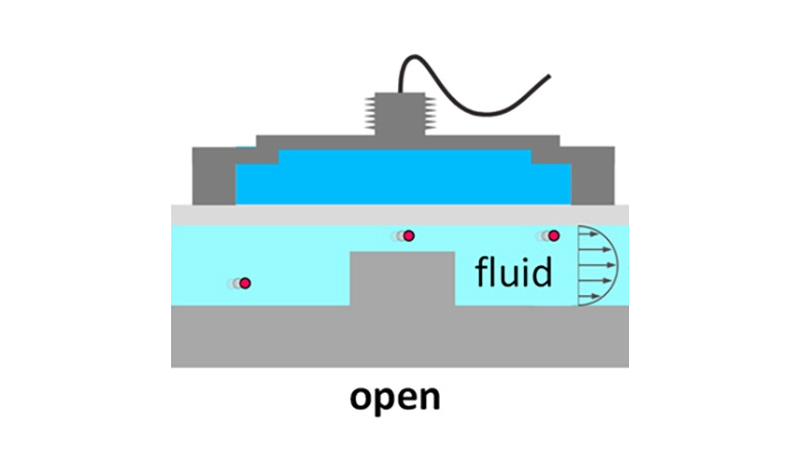
The researchers at OMU developed a system that opens and closes a nanovalve in a nanofluidic gadget by making use of exterior stress. They fabricated a skinny, versatile glass sheet on the highest, and a tough glass plate with small constructions forming nanochannels and nanovalve seats on the underside. By making use of exterior stress to the versatile glass sheet to open and shut the valve, they succeeded in regulating the circulate of particular person molecules in resolution.
The staff additionally found that once they trapped single fluorescent (dyed) molecules within the nanospace contained in the valve, the fluorescence of the one molecules grew to become brighter. This occurred as a result of the small area made it tougher for single molecules to maneuver round randomly.
Professor Yan Xu, who led the research, explains that “this impact of fluorescence sign amplification might assist with detecting very small quantities of pathogens for early analysis of illnesses equivalent to cancers and Parkinson’s, with out requiring costly gear.”
This breakthrough has the potential to be helpful in lots of different methods – “its purposes are limitless,” in keeping with Xu’s staff. It might assist in creating personalised medicines for uncommon illnesses, or creating higher shows and batteries, for instance. It might be a big step in direction of freely assembling supplies utilizing single molecules as constructing blocks in resolution.
“We now have been addressing varied challenges by proposing and selling the idea of ‘Single-Molecule Regulated Chemistry (SMRC),’ the place molecules are handled as constructing blocks and all processes concerned in chemical and biochemical reactions in resolution are carried out on a single-molecule foundation.
“The one-molecule valve marks step one in direction of this objective, which might someday revolutionise chemistry, biology, and supplies science, in addition to remodel varied industries,” concludes Professor Xu.
Comments »
When you loved this text, please take into account sharing it: